Nvidia and its Zero-Billion-Dollar Market Moat
Nvidia is, today, the most valuable company in the world. Its GPUs train and run essentially every frontier AI model. It controls roughly 80% of the AI accelerator market and earns 75%-plus gross margins doing it. It is the picks-and-shovels provider to the AI revolution, and no competitor comes close.
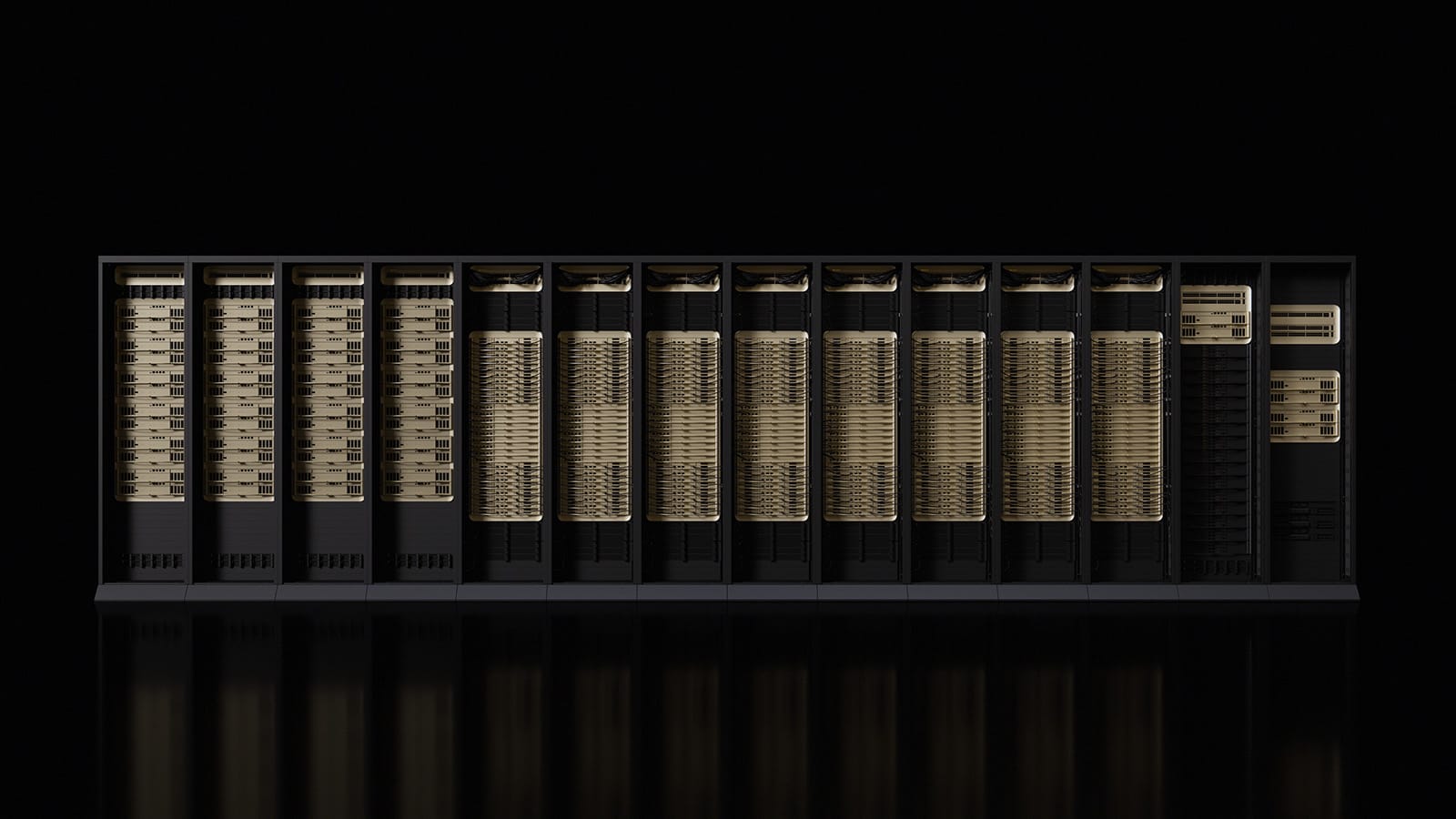
A simplified version of the story is that Nvidia, a leader in the gaming graphics industry, happened to be sitting on a parallel-processing architecture that turned out to be the right shape for AI workloads. But if this was the whole story, why isn't Nvidia today fighting an open, fierce battle against other chip manufacturers for AI market share, instead of standing alone with no close second?
The longer version of the story is that Nvidia's market position today was the result of a deliberate, expensive, but ultimately company-defining decision that Jensen Huang made almost two decades ago around CUDA - a decision that required almost a decade of perseverance through real financial pain before any payoff even began to show.

The trade-off Jensen made, and what it costed Nvidia over many years, reveals why truly durable moats are so hard to build.
CUDA is the moat
A graphics card is, at its core, a piece of silicon optimized for doing thousands of small calculations in parallel. CUDA (an abbreviation for Compute Unified Device Architecture) is Nvidia's proprietary software layer that enables a developer to program its GPUs and turn it into a general-purpose computational engine that can train a neural network, simulate a fluid, or run a weather model.
Most of the AI software stack, including dominant frameworks like PyTorch and TensorFlow, was built CUDA-first. A graduate student starting an AI PhD today inherits a stack in which the default, the thing that "just works", is CUDA.
A competitor with better silicon does not get to compete on silicon alone; they have to also rebuild a software ecosystem that took Nvidia almost two decades and billions of dollars of R&D to accumulate, while simultaneously convincing a critical mass of researchers, framework maintainers and hyperscalers to rewrite code that already runs. AMD has tried with ROCm. Intel has tried with oneAPI. Even Google, despite building TPUs and a sophisticated software stack around them, has not displaced CUDA as the industry-standard AI development platform
Trading margin for ubiquity
In the mid 2000s, Nvidia was already a great company, a market-leading player in the fast-growing consumer gaming graphics market, albeit one that was also fiercely competitive and fast-moving where a single mis-step in a product cycle could spell a death sentence. The company had already faced a number of existential scares in its short existence.
Against that backdrop, Nvidia noticed something interesting on the peripherals of its customer base. Scientists were using Nvidia's graphics shader language to solve equations, bending a tool meant for rendering pixels into something closer to a general-purpose math engine. The same parallel architecture that drew thousands of pixels at once turned out to be uniquely well-suited to the kind of computational problems they were trying to solve. If researchers were already painstakingly hacking GeForce cards into compute devices, Nvidia could build them a real software layer and enter a market that didn't yet exist.
General-purpose GPU computing was what Jensen himself called a "zero-billion-dollar market." There was no TAM slide you could put in a pitchbook, no comparable you could point to, no Euromonitor report you could cite. But by definition, that also meant no competitors.
For CUDA to claim that market, developers had to adopt it. And for developers to adopt it, CUDA had to already be on the machines they used. Nvidia had a structural advantage few other companies had: an installed base of millions of consumer GeForce cards already sitting in the homes of gamers, students, and researchers around the world. It had a path to ubiquity by shipping CUDA on its consumer products line, not just on the niche professional units.
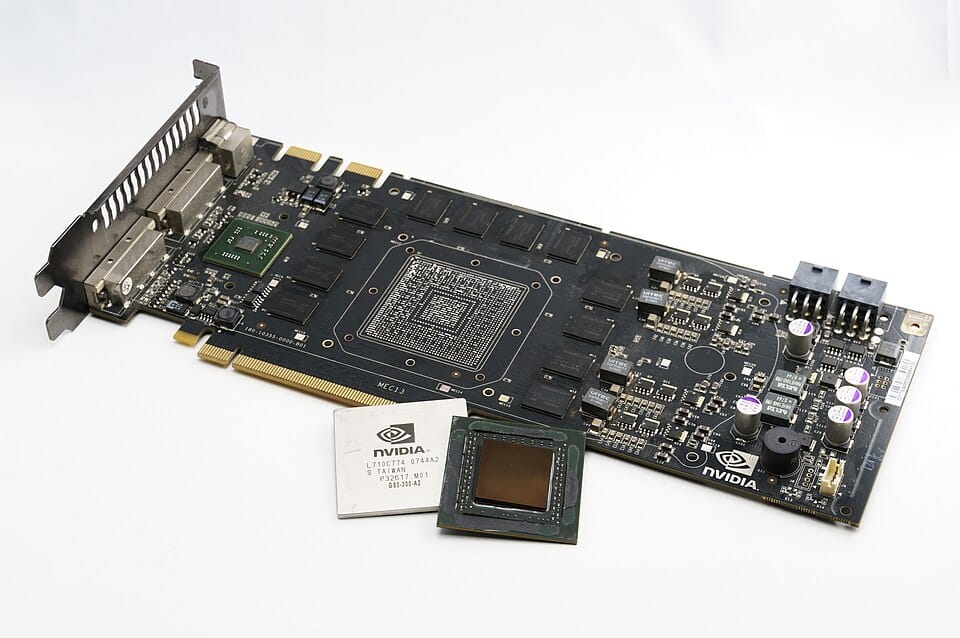
The G80 that launched alongside CUDA in late 2006 was, at the time, the largest commercial GPU ever built, and a non-trivial portion of that silicon existed for compute capabilities that a gaming customer would never use and would never pay for. Making a GPU CUDA-capable required general-purpose programmable cores, more on-die memory, more complex scheduling logic, and the die area to accommodate all of it.
That extra silicon hit the income statement in two places. Bigger dies meant fewer chips per wafer and lower yields resulting in lower gross profit margins. The architecture also demanded hundreds of millions of dollars in R&D every year, across every generation of GeForce cards.
Wall Street did not like this at all. CUDA shipped on the GeForce 8800 in late 2006 with Nvidia's market cap at around $12 billion; by the trough of the financial crisis it had fallen to roughly $2-3 billion, and even after the recovery the stock spent the better part of half a decade going sideways. Despite this backdrop, the company kept pouring money into CUDA.
Moats require pain
Moats are not a feature you can simply choose to add. A few companies were lucky enough to be born with one (e.g. Visa and Mastercard inherited theirs from having been started as bank-owned consortiums), but for everyone else, building a real moat means absorbing real financial costs for years before any payoff arrives.
If a moat were a no-brainer on a spreadsheet and looked good on a PowerPoint slide, everyone would build one, and the efficient market would do the rest. The "moat" would arbitrage itself away before it ever became one.
The real arbitrage is precisely the kind of pain that most professional management teams, boards, and public-market investors are structurally disincentivized to bear. Nvidia could make the CUDA trade-off only because it was run by a founder who owned a meaningful stake in the company and had the credibility, and the conviction, to stay the course.
Trading the future for a quarter
Picture the counterfactual. Sometime in 2013, around when Wall Street was getting restless and activist investors were circling, Jensen folds under investor pressure. He calls a special investor day and announces that Nvidia will scale back its investment in CUDA and refocus the company on its core gaming graphics business, promising a leaner roadmap and improved gross margins over the following quarters.
Nvidia stock rallies immediately. Sell-side notes go out that same afternoon with headlines like “Discipline Returns to Santa Clara.” Analysts and fund managers congratulate themselves on having successfully pushed Jensen back toward his “core competency”: a graphics chip company serving the gaming market.
Over the next few quarters, the incentive system underpinning modern capital markets does exactly what it was designed to do. For analysts, portfolio managers, the board, shareholders, and Jensen himself, the rise in the stock price means that every participant in the system is materially better off immediately, and most of them collect a larger bonus cheque that year. A ruthlessly efficient capital market has corrected yet another capital allocation mistake. The system worked.
But when the deep learning revolution arrives at scale a few years later, there is no massive installed base of developers already fluent in CUDA waiting to execute on Nvidia silicon. AI workloads flow instead toward whatever compute substrate is cheapest, most accessible, or easiest to program against. The overwhelming concentration of AI development on American silicon and American software, something that today materially underpins Western leadership in artificial intelligence, no longer looks inevitable.
Nvidia would have ended up as just another chip manufacturer fighting for share in AI, the same way it had been fighting for share in consumer gaming graphics. Trillions of dollars of future enterprise value would never have crystallized. And nobody would ever have known what was traded away in 2013 for a few hundred basis points of additional gross profit margin.